If you’ve been creating content for a while, you’ve probably received a message that sounds something like this: “Hi, we’d love to collaborate with you. We’ll send you our product, and in return we’ll need one Reel and two Stories.”
No payment mentioned, just the product.
Sometimes that’s a great deal, you might already want the product, the brand fits your content and the amount of work involved is small enough that you’re happy to do it. Other times, the brand is offering a ₹2,000 product and asking for a Reel that will take half a day to plan, shoot and edit.
At this point, everything starts to become a little confusing.
The barter deal can’t be viewed as a proper agreement, there are obvious benefits for the influencer, but instead of money, there is something else that needs to be put into a bargain. There is still a question of whether you get something valuable in exchange for your sacrifice.
In 2026, the development of the influencer market means that the whole process of barter collaboration becomes much more complicated than just asking how much something costs.
What Is a Barter Collaboration?
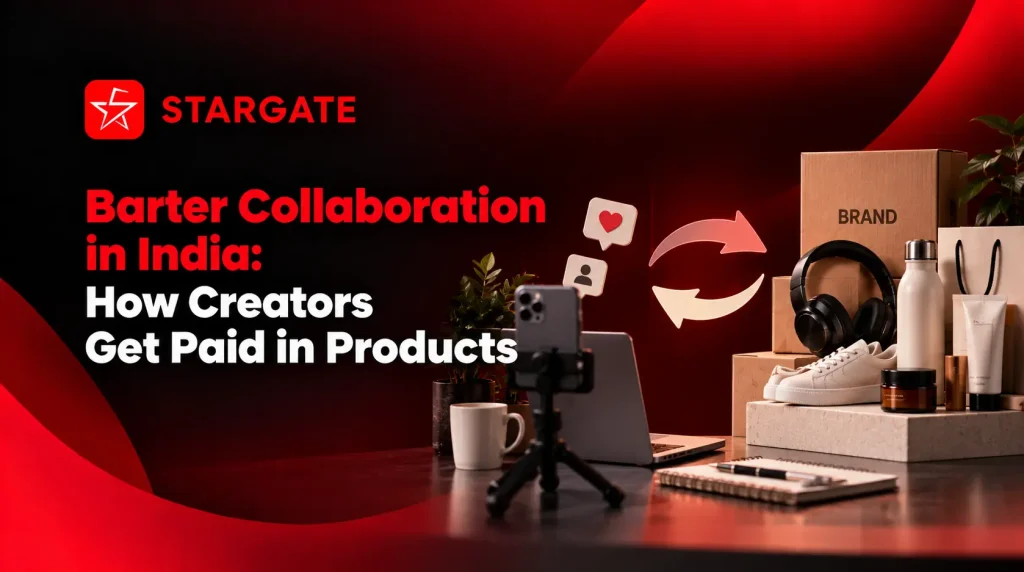
A barter collaboration is a brand-creator arrangement where the creator receives a product, service or experience instead of direct monetary payment for the agreed content.
- A skincare brand might send you a ₹3,000 product bundle in exchange for a Reel.
- A restaurant might offer a complimentary meal for a Reel and a few Stories.
- A hotel might provide a stay in exchange for content during the visit.
- A fashion brand might send you an outfit and ask you to create a post wearing it.
The arrangement itself is simple.
The tricky part is deciding what that product or experience is actually worth to you.
A product being listed at ₹5,000 doesn’t automatically mean you’ve received ₹5,000 worth of compensation. If you would never buy it, don’t need it and wouldn’t use it after the campaign, the retail price doesn’t tell you much.
That’s the first thing to understand about barter. The brand’s product value and your compensation value are not always the same thing.
How Does Barter Collaboration Work in India?
Most barter agreements operate under a straightforward system. The company contacts the creator and communicates its wishes in return for a product or service. After the creator considers whether this proposition is advantageous, and if they both agree, the company delivers the product or provides the service; then the creator will come up with the content, the campaign is launched and the payment is made.
Who pays for shipping?
- How many posts are required?
- Does the creator need to send the content for approval?
- How many revisions are allowed?
- Can the brand reuse the Reel as an advertisement?
- What happens if the product arrives late?
- What if the creator receives the wrong product?
And perhaps the most important one:
What happens if the work turns out to be much bigger than expected?
A barter collaboration still needs clear terms.
“Free product for content” isn’t a complete agreement.
Why Do Brands Offer Barter Collaborations?
From a brand’s side, barter can be an efficient way to work with creators, particularly when the product itself has meaningful value and the campaign doesn’t require a large production effort.
It can also help brands test creators before moving into paid campaigns.
For example, a new skincare brand may want to work with several micro-creators in a particular city or niche. Instead of starting with a large paid campaign, it can offer products to creators who genuinely fit the audience and see how the content performs.
That can work well for both sides.
But there’s an important difference between:
“We’d like to send you our product and see if you’d like to create something.”
and:
“We’ll send you a product worth ₹1,500 if you create two Reels, three Stories, attend an event and give us six months of ad usage.”
Both are technically barter.
They are not remotely the same deal.
When Is a Barter Collaboration Actually Worth Accepting?
This is probably the question most creators have and there isn’t one follower count, engagement rate or product value that gives you the answer.
Instead, look at four things:
- What you’re receiving.
- What you’re giving.
- How much work is involved.
- Whether the collaboration helps you in some other meaningful way.
If all four make sense, the barter offer may be worth accepting.
When You Already Want the Product?
This is the easiest situation, if you were already considering buying the product yourself, receiving it through a collaboration has real value. Maybe you’re a beauty creator and the brand is offering products you regularly use. Maybe you’re a travel creator and the deal is a hotel stay you would have paid for anyway. Maybe you’re a fitness creator and you’re being offered equipment you’ve actually been looking to buy.
In those cases, barter can make sense because the product isn’t just something you’re accepting for the sake of having something to show but you genuinely want it.
Ask yourself:
Would I spend my own money on this if the brand hadn’t contacted me?
If the answer is yes, you’re already looking at the offer differently.
When the Product Fits Your Content?
A product doesn’t have to be something you personally planned to buy.
It should at least make sense for your audience.
- A fashion creator receiving clothing from a relevant brand has a natural content opportunity.
- A food creator working with a restaurant can create content that fits what their audience already expects.
- A tech creator receiving a new gadget has an obvious reason to talk about it.
But if the product has nothing to do with your content, you’re likely creating a problem for yourself. You have to figure out how to introduce something your audience never asked about, and the brand may still expect strong results. That’s usually not worth it just because the package is free.
When Should You Refuse a Barter Collaboration?
A free product can still be an expensive deal.
Not financially, necessarily. In time.
When the Brand Wants Too Many Deliverables
This is one of the biggest problems with barter campaigns.
The brand starts with:
“We’ll send you our product.”
Then the requirements become:
- One Reel
- Three Stories
- One static post
- Product photography
- Raw footage
- Two revisions
- A product link in your bio
- Permission to reuse the content
At that point, the product is no longer the only thing you should be thinking about. You’re being asked for a significant amount of creative work. A barter collaboration can work for a simple product mention. It becomes much harder to justify when the brand expects professional production from you.
When You Don’t Actually Want the Product?
This sounds obvious, but creators accept products they don’t want all the time.
- Maybe the product is expensive.
- Maybe the packaging looks impressive.
- Maybe the brand is well known.
But if you have no use for it, you’re essentially accepting something you’ll later have to store, give away or sell, in exchange for work. The price tag doesn’t change that.
When the Brand Wants Usage Rights?
This one gets overlooked surprisingly often as a brand may offer you a product worth ₹3,000 and ask for a Reel, that sounds simple. Then somewhere in the agreement you find that the brand wants to use the Reel in paid advertisements for six months.
That’s a different deal. Your content now has value beyond the original post because the brand can use it to promote itself commercially.
Before accepting a barter collaboration, check whether the brand wants:
- Organic reposting
- Website usage
- Paid advertising
- Social media ads
- Whitelisting or partnership ads
- Raw footage
- Perpetual usage rights
If the answer is yes, don’t look only at the value of the product. Look at the value of the content you’re giving the brand.
The Product’s MRP Isn’t Your Creator Rate
Suppose a brand offers you a product with an MRP of ₹8,000.
It might be tempting to think:
“My Reel is worth ₹8,000, so this is basically a paid collaboration.”
Not necessarily.
The brand’s MRP isn’t automatically your creator fee.
You still need to consider:
- How much time you’ll spend creating the content.
- Whether you need to travel.
- Whether you need equipment or other production costs.
- How many revisions are involved.
- Whether the content needs professional editing.
- Whether the brand gets advertising rights.
- Whether the product has actual value to you.
- Whether you’re expected to publish on your own profile.
A product worth ₹8,000 can be a great barter deal but it can also be a terrible one, the number on the price tag doesn’t decide that for you.
Barter vs Paid Collaboration
The difference is fairly simple.
With barter, the compensation is a product, service or experience.
With a paid collaboration, the creator receives money for the agreed work.
Here’s where the distinction becomes useful:
Barter Collaboration
- Compensation: You get something instead of cash payment.
- Direct Income: Money is generally not involved in this process.
- Best For: Appropriate promotions where the product is really useful to you and the content is not so complex.
- Product Value: This is important as the product is basically what you are using in exchange for your work.
- Multiple Deliverables: Many Reels, Stories, or any other types of the content do not usually pay off unless the product is of high value.
- Content Resale: You should talk about the possibility of the brand reusing your content online or on social media.
- Creator Sustainability: If you work on barter basis too frequently, it may prove difficult to make money out of your content creation.
Paid Collaboration
- Compensation: You will get paid in cash for any content and other results agreed upon.
- Direct Income: The collaboration means direct income for you.
- Best For: Professional activations that require planning, production, several deliverables or a lot of creativity.
- Product Value: The product itself is less important as you are paid for your creativity.
- Multiple Deliverables: You may negotiate several Reels, Stories, posts or other deliverables within one campaign cost.
- Content Usage: Usage rights and rights for advertising and other commercial uses are included into negotiations with the creator’s fee.
- Creator Sustainability: Paid collaborations are usually more appropriate if you want to create a sustainable creator business and put a lot of time into making content regularly.
Neither option is automatically better. A creator can accept a barter deal and get excellent value from it.
A creator can also accept a paid deal that isn’t worth the effort if the fee is too low or the campaign requirements are unreasonable. The deal needs to make sense as a whole.
What About Small or New Creators?
This is where barter can actually be useful. If you haven’t built a portfolio yet, doing brand collaborations can help give you valuable experience that you wouldn’t be able to obtain otherwise.
You will learn how brands send out briefs, how approvals and changes are handled as well as how to create sponsored content under pressure.
You may also get content for your portfolio, but there’s a point where “I’m building my portfolio” becomes an excuse for doing professional work for free.
Don’t let that happen indefinitely. You don’t have to be popular before your career can start. As long as you are functioning as a productive content creator, building an audience that interacts with you and responding to brand requirements, you can begin doing paid campaigns.
How To Negotiate a Barter Collaboration?
You don’t have to respond to every barter offer with either “yes” or “no.”
There’s a third option.
Negotiate.
If you like the brand but the proposed deliverables are too much, tell them.
For example:
“I’d love to collaborate with the brand. For the proposed Reel and Stories, I usually work on a paid basis. If you’re open to it, I’d be happy to discuss a paid package. Alternatively, we could explore a simpler product-only collaboration.”
That does two things.
It tells the brand you’re interested and it also makes your boundaries clear.
You can offer different options depending on the campaign.
For example:
- Option 1: Product-only = one simple Story mention.
- Option 2: Product + payment = Reel + Stories.
- Option 3: Paid campaign = Reel + Stories + usage rights.
Now you’re not simply rejecting the brand.
You’re giving them a way to work with you.
Can You Get Both the Product and Money?
Yes, there’s no rule saying a collaboration has to be entirely barter or entirely paid. A hybrid deal can include the product plus a monetary fee. This makes sense when the product has genuine value to you but the campaign still requires significant creative work.
A case in point is a beauty creator who might be glad to accept the products of a brand but will also charge for producing a well-made Reel. It is possible for a content creator to accept a hotel’s free accommodation service, but when several contents are expected from the creator in return, it is at that point the creator will request compensation. The most important thing in the agreement is that everybody knows exactly what their role will be once the campaign is launched.
What Should Be Written Down Before Accepting?
Even a simple barter deal deserves something in writing. You don’t necessarily need a complicated contract for every product mention, but you should at least have the basic terms confirmed.
Make sure you know:
- What product or service you’re receiving.
- Its quantity or scope.
- What content you’re expected to create.
- How many deliverables are required.
- When the content is due.
- Whether the content needs approval.
- How many revisions are included.
- Whether you need to disclose the collaboration.
- Whether the brand can reuse your content.
- Whether paid advertising usage is included.
- Who covers shipping or travel costs.
This becomes particularly important when the product is expensive or the campaign involves multiple deliverables. A DM saying “We’ll send you the product and you can post something” isn’t very useful if the expectations change later.
How Stargate Makes Barter Collaborations Easier?
This is one area where a structured creator-brand platform can make a difference. With traditional barter outreach, the conversation might happen through Instagram DMs, then move to WhatsApp, then email, then a spreadsheet somewhere on the brand’s side.
The creator has one version of the deal, while the brand has another and someone eventually asks, “Wait, were we supposed to do two Stories or three?”
Stargate introduces barter agreements into the process of creator-brand partnerships. The platform shows barter agreements in the list of the opportunities available for creators, alongside paid partnerships and events.
Users are able to see the details of the campaign and the amount of money they might get beforehand; they can apply for the necessary opportunities and cooperate with brands via the platform. The platform goes further and provides structured project proposals, negotiations, digital contracts, item tracking, and payment by milestones.
That means brands do not have to communicate with creators through Instagram.
They can set up the project, find the required creators, manage the proposals, and consolidate everything in one place. Stargate’s creator discovery also allows brands to filter for factors such as category, location, budget, platform and language.
And there is a useful example on Stargate itself. One brand testimonial describes a campaign where the brand and creator agreed on a barter deal through the platform, with the campaign closing within a day.
That is really the point, a barter doesn’t need to mean informal.
You can exchange a product instead of money and still have a proper campaign, clear deliverables and a clear understanding of what each side is receiving.
The Biggest Mistake Creators Make With Barter
It’s accepting a deal because they’re afraid another opportunity won’t come, that’s understandable. When you’re getting your first few brand messages, even a product-only offer can feel like proof that brands are noticing you.
But you don’t have to say yes to everything to build a creator career, the right barter collaborations can introduce you to brands, give you useful products, help you build relevant experience and sometimes lead to paid work later.
The wrong ones can leave you spending hours creating content for something you didn’t want in the first place. Learn to tell the difference.
Ready to connect, discover, and collaborate? Download the Stargate app on the App Store or Google Play and get started today.
Final Thoughts
A barter collaboration can be a perfectly good way for a creator and a brand to work together. The product just needs to be worth something to you, the campaign needs to fit your content and the amount of work should make sense for what you’re receiving.
If a brand wants one simple Story in exchange for a product you genuinely want, there may be no reason to complicate things.
If it wants three Reels, five Stories, raw footage, multiple revisions and advertising rights, then a product alone probably isn’t enough.
The important thing is to stop looking at barter as “free stuff in exchange for a post.”
You’re exchanging your time, creativity and access to your audience for something the brand believes has value, make sure you believe it does too.
And if you’re looking for barter opportunities without chasing brands through DMs, Stargate lets creators discover brand collaborations, including barter deals, review campaign details and connect with brands through one platform.
FAQs
What is a barter collaboration?
- A barter collaboration is a brand-creator arrangement where the creator receives a product, service or experience instead of direct monetary payment for agreed promotional content.
Is barter collaboration worth it for Indian creators?
- It can be, particularly when the product has genuine value, fits the creator’s niche and the campaign requires relatively little work. High-effort campaigns are usually better suited to paid or hybrid arrangements.
Does a barter collaboration mean the product is my payment?
- Yes, the product or service is generally the compensation agreed between the brand and creator. However, its retail price doesn’t automatically equal the value of your creative work.
Can small creators accept barter deals?
- Yes, barter can help newer creators gain experience with briefs, approvals, sponsored content and brand communication. But creators shouldn’t feel obligated to accept every product-only campaign indefinitely.
How do I ask a brand to pay instead of offering barter?
- Thank the brand for the opportunity, explain that the proposed deliverables fall under your paid collaboration work and offer a suitable package or a smaller barter arrangement.
Can a barter collaboration include money as well?
- Yes, a hybrid deal can include both a product or service and a monetary payment, particularly when the campaign requires significant creative work or commercial usage rights.
Should creators get a barter agreement in writing?
- Yes, at minimum, confirm the product or service, deliverables, timeline, approval process, revisions and content usage rights before starting the campaign.
Can I find barter collaborations on Stargate?
- Yes, Stargate lists barter deals among the collaboration opportunities available to creators. Creators can discover campaigns, review requirements and apply to relevant brand opportunities through the platform.